Adjacency
Two tiles of a tiling are adjacent in one of three ways:
| Kind | Meaning |
|---|---|
"edge" |
The tiles share an edge. |
"vertex" |
The tiles share an edge or a vertex. |
"vertex-only" |
The tiles share exactly a vertex and no edge. |
"vertex" is the union of "edge" and "vertex-only". The kinds are the type AdjacencyKind.
The lattice table
In an isohedral tiling the neighbors of a tile depend only on the aspect of the tile, not on its cell. Every type
therefore has a table (TilingType.adjacency) with one row per neighbor relation:
A tile with cell (u, v) and the given aspect has a neighbor with cell (u + d_cell_u, v + d_cell_v) and aspect
neighbor_aspect. kind is 0 if the two tiles share an edge and 1 if they share a vertex only. The table is symmetric:
if tile A lists tile B, tile B lists tile A.
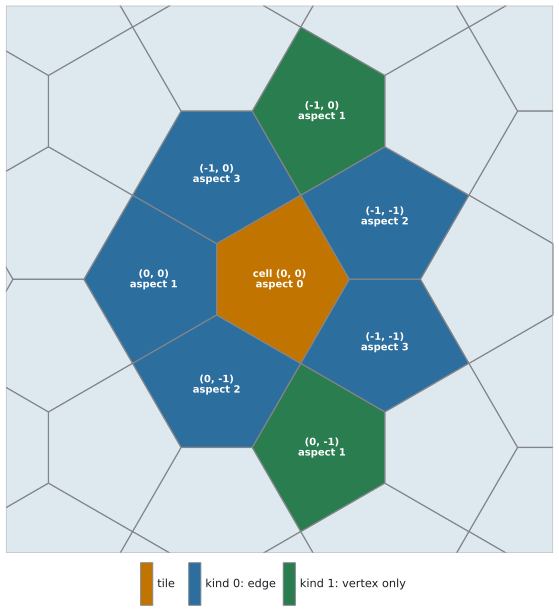
get_type(28).adjacency for aspect 0: each neighbor is labeled with (d_cell_u, d_cell_v) and neighbor_aspect. Edge neighbors (kind 0) are blue, vertex-only neighbors (kind 1) are green.The offsets are in cell coordinates and the aspect is an index, so the table does not depend on the parameters, the scale or the frame of the tiling, or on where the tiles are. Two tilings of the same type with different parameters, scales or rotations have the same adjacency for the same cells and aspects. The table needs no geometry, and it is exact: there is no tolerance, and shared vertices that coincide up to rounding are never missed or merged.
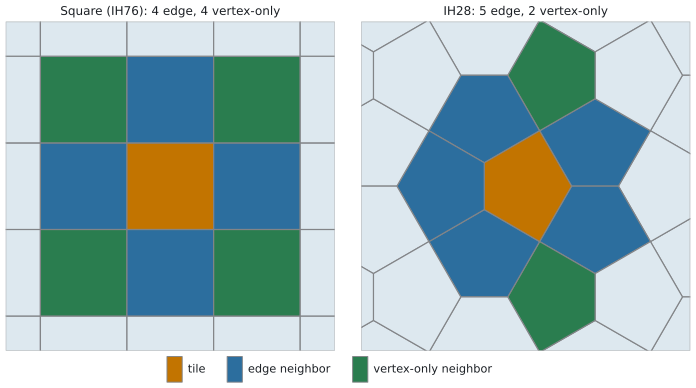
For the square tiling (type 76) there is one aspect and the table has eight rows: the offsets (+-1, 0) and (0, +-1)
with kind 0 (four edge neighbors) and (+-1, +-1) with kind 1 (four vertex-only neighbors).
TileSet.adjacency(kind) looks up, for every tile of the set and every row of the table for its aspect, whether the tile
at the neighboring cell and aspect is in the set. A tile that is not in the set is dropped, so tiles at the border of a
set have fewer neighbors. lattice_adjacency(cell, aspect, tiling_type, kind) does the same for arrays of cells and
aspects without a tiling object.
The matrix format
The result is a scipy.sparse.csr_array of dtype bool and shape (n, n), with n the number of tiles. Row and column
i refer to tile i of the tile set, in the order of TileSet.cell. The matrix is symmetric and its diagonal is empty.
The indices of the neighbors of tile i are adjacency.indices[adjacency.indptr[i]:adjacency.indptr[i + 1]], which
TileSet.neighbors(i, kind) returns sorted. Each call builds the whole matrix; TileSet.neighbor_lists(kind) returns the
sorted neighbors of all tiles from one matrix.
Worked example
Four squares in a 2 x 2 block and one square far away, as tiles of the square tiling.
tiles = IsohedralTiling.square().tiles([[0, 0], [1, 0], [0, 1], [1, 1], [3, 3]], 0)

edge = tiles.adjacency("edge")
vertex = tiles.adjacency("vertex")
only = tiles.adjacency("vertex-only")

print(edge.toarray().astype(int))
print(only.toarray().astype(int))
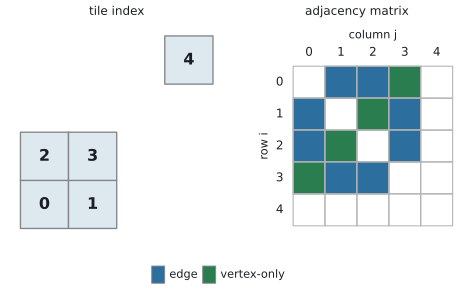
edge (blue) and only (green) as one grid. Row and column i are tile i; both matrices are symmetric with an empty diagonal.Tile 0 (cell (0, 0)) has edge neighbors 1 and 2 (cells (1, 0) and (0, 1)) and the vertex-only neighbor 3 (cell
(1, 1)). The tile at (3, 3) has no neighbor in the set. The same cells and aspects on a scaled and rotated tiling
give the same matrices.
moved = IsohedralTiling.square().scaled(100).rotated(33).tiles(tiles.cell, tiles.aspect)

print(tiles.neighbors(0, "edge"), tiles.neighbors(0, "vertex-only"))  # [1 2] [3]
assert (moved.adjacency("vertex") != vertex).nnz == 0
assert (vertex != edge + only).nnz == 0
The geometric method
geometric_adjacency(polygons, tol=1e-6) computes adjacency for any list of polygons, each given as a (k, 2) array of
vertices, and returns the pair (edge, vertex_only) of sparse boolean matrices of the same format. It identifies
vertices that are closer than tol (in the units of the coordinates) as one vertex, and counts for each pair of polygons
the vertices they share. Two polygons that share two or more vertices are edge neighbors; two that share exactly one are
vertex-only neighbors. Only the vertices are compared: a vertex of one polygon that lies on the interior of an edge of
another polygon does not count as shared. Choose tol smaller than the shortest edge and larger than the rounding error
of the coordinates.
from isotile import geometric_adjacency

edge_g, only_g = geometric_adjacency(list(tiles.vertices()))
assert (edge_g != edge).nnz == 0
assert (only_g != only).nnz == 0
For the tiles of an IsohedralTiling the two methods give the same matrices. The lattice method is the one to use for
tiles of a tiling: it does not depend on a tolerance and does not compare coordinates. The geometric method serves polygons
that no tiling generated.
The Benchmark page gives the time of both methods at 1,000 to 100,000 tiles.