isotile
Isohedral tilings in NumPy: the 81 isohedral tiling types, vectorized tile generation and exact tile adjacency from a lattice table. isotile keeps the tiling type numbers (IH1 to IH93) and the parameter format of tactile.
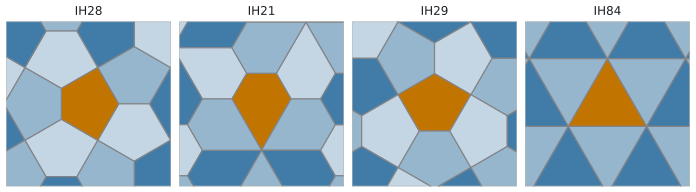
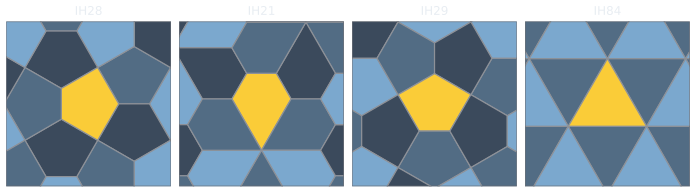
- Tiles are generated for a rectangle or for a target tile count, as arrays of cells, aspects and affine transforms.
- Adjacency (shared edge, shared vertex, vertex only) comes from a table of the tiling type, as a scipy sparse boolean matrix. It does not depend on the parameters, the scale or the position of the tiling.
- Squares, hexagons, any triangle and any simple quadrilateral are named constructors of the same class.
- A parameter set that makes the prototile self-intersecting raises
ValueError;check_prototilereports the edges at fault without constructing a tiling.
Install
Python 3.10 or newer.
Example
Generate a tiling of type IH7 that covers a region, and read the adjacency of its tiles.
from isotile import IsohedralTiling

tiling = IsohedralTiling(7)
tiles = tiling.fill_region((0, 0, 10, 6), n_tiles=200)
print(len(tiles), tiles.vertices().shape)

edge = tiles.adjacency("edge")  # scipy.sparse.csr_array of bool, (n, n)
print(edge.shape, edge.nnz)
print(tiles.neighbors(0, "edge"))  # indices of the tiles that share an edge with tile 0
Where to continue:
- Quickstart: the common calls, step by step.
- Concepts: types, parameters, cells, aspects, frames and the tile selection.
- Adjacency: the three kinds of adjacency and how they are computed.
- API reference: every public name.